
How IELTS is scored trips up more candidates than most people expect, because it isn’t one process. Your result is four separate section scores, produced by two different marking systems, then averaged and rounded into the overall band you actually report. That distinction matters more than most guides let on, because it changes how you should decide what to study next.The short answer
Each of the four sections, Listening, Reading, Writing, and Speaking, gets its own band score from 0 to 9, in half-band increments. Your Overall Band Score is the average of those four, rounded to the nearest half band using a specific rule covered below.
Listening and Reading are scored differently than Writing and Speaking
This is the part most explanations gloss over. Listening and Reading are marked as raw scores, out of 40 questions each, which then convert to a band score using a published conversion table. This means the exact number of correct answers needed for a given band isn’t fixed, it depends on that test version’s difficulty, calibrated by the test maker.
Writing and Speaking don’t have a raw score at all. There’s no counting correct answers. Instead, an examiner assesses your performance against four separate criteria for each section:
- Writing: Task Achievement (or Task Response), Coherence and Cohesion, Lexical Resource, and Grammatical Range and Accuracy.
- Speaking: Fluency and Coherence, Lexical Resource, Grammatical Range and Accuracy, and Pronunciation.
Your band for each of these sections is essentially the examiner’s assessment across all four criteria, averaged into one score. This matters practically: one wrong answer near a boundary in Listening or Reading can shift your band in a way that one small grammar slip in Speaking usually won’t, since the two systems measure fundamentally different things.
The rounding rules, and why they matter strategically
Once your four section bands exist, they’re averaged and rounded using a fixed rule:
- If the average ends in .25, it rounds up to the next half band (6.25 becomes 6.5).
- If the average ends in .75, it rounds up to the next whole band (6.75 becomes 7.0).
- Any other value rounds to the nearest half or whole band in the ordinary way.
This isn’t just trivia. Because rounding always favors you at the .25 and .75 marks, a single strong section can pull your entire overall band up more than evenly distributed effort would.
A worked example: why your weakest section matters most
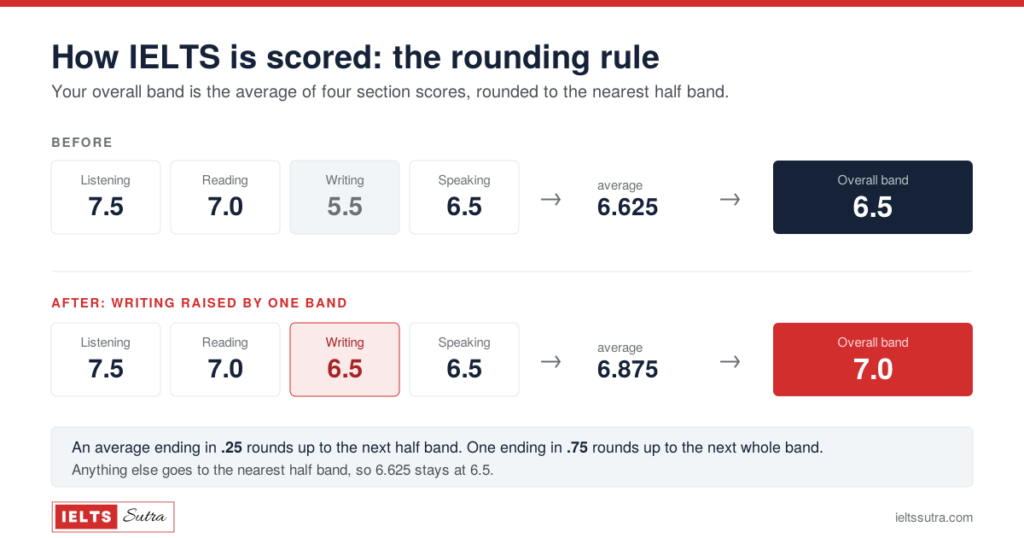
Say your four section bands are Listening 7.5, Reading 7.0, Writing 5.5, Speaking 6.5. The average is 26.5 ÷ 4 = 6.625, which rounds to 6.5 overall (6.625 sits between .5 and .75, so it rounds to the nearer value, 6.5, not up to 7.0, a common point of confusion covered below).
Now raise only the weakest section, Writing, from 5.5 to 6.5. The new average is 27.5 ÷ 4 = 6.875, which rounds up to 7.0. A single one-band improvement in your weakest section moved the overall score a full half band, more than a smaller improvement spread across all four sections would likely achieve. This is the practical case for diagnosing your weakest section first, rather than studying all four equally.
Common scoring misunderstandings
- Assuming any decimal above .5 rounds up to the next whole band. Only .75 does that. An average of 6.625 rounds to 6.5, not 7.0.
- Assuming Listening and Reading work the same way as Writing and Speaking. One is raw-score conversion, the other is criteria-based examiner judgment, they aren’t interchangeable systems.
- Studying all four sections equally regardless of current scores. As the worked example shows, lifting your weakest section is usually the more efficient path to a higher overall band.
- Treating the overall band as the only number that matters. Many universities and visa categories set minimums per section, not just overall, so a high overall average with one very low section can still fail a specific requirement.
FAQ
Does IELTS round up or down? Both, depending on the exact average. Averages ending in .25 or .75 round up. Other values round to the nearest half or whole band, which can mean rounding down.
How is IELTS Listening and Reading scored differently from Writing and Speaking? Listening and Reading use a raw score out of 40, converted to a band via a published table. Writing and Speaking are assessed directly by examiners against four scoring criteria each, with no raw score involved.
What is a raw score in IELTS? It’s the number of correct answers out of 40 in Listening or Reading, before it’s converted into a band score.
Which section should I improve first? Usually your weakest one. Because of how averaging and rounding work, raising your lowest section tends to move your overall band more efficiently than spreading equal effort across all four.
Reach out to us at IELTS Sutra, email us at contact@ieltssutra.com, or call +91 9056513461.
Also read: Best IELTS preparation books and self-study material