
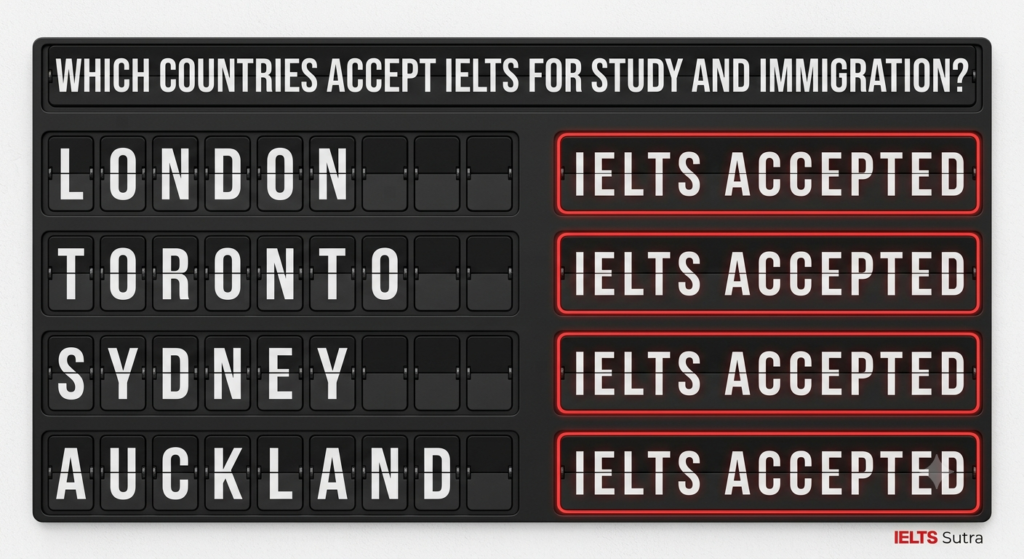
More than 140 countries and 11,000 institutions recognise IELTS, but that headline number doesn’t answer the question most people have: does my target country accept it, for my purpose, and which version of the test do I need? Those three details change more often than most lists let on, so this guide is organized around them rather than around a generic country directory.
Do you actually need IELTS? (Check this first)
Before booking a test, it’s worth checking whether you need one at all. Most major study destinations, including the UK, USA, Canada, and Australia, will waive the English test requirement if you completed your last two or more years of education with English as the medium of instruction, usually verified through a Medium of Instruction (MOI) letter from your previous institution. Some universities also accept alternative tests, PTE, TOEFL, or the Duolingo English Test, in place of IELTS, so check the specific admissions page directly before assuming IELTS is mandatory.
If you’re applying for immigration or a points-based visa rather than university admission, this waiver route generally doesn’t apply, immigration authorities usually require a language test regardless of your education history.
Countries that accept IELTS for study
For university admission, IELTS Academic is the relevant version almost everywhere. Score requirements vary by university and course, not just by country, but as a general range:
- United Kingdom: most undergraduate programs ask for 6.0-6.5 overall, competitive postgraduate programs often 6.5-7.5
- United States: requirements vary widely by university, commonly 6.0-7.0, and IELTS is accepted at over 3,000 US institutions despite the country’s TOEFL-heavy reputation
- Canada: typically 6.0-6.5 overall for undergraduate, sometimes higher for professional programs
- Australia: most universities ask for 6.0-6.5, with several introducing higher minimums in 2025
- New Zealand: generally 6.0-6.5, similar to Australia
- Ireland, Germany, Netherlands, and other EU study destinations: accept IELTS for English-taught programs, usually in the 6.0-6.5 range; Germany also offers several IELTS-exempt pathways worth checking if cost is a concern
Countries that accept IELTS for immigration and PR
This is where the details matter more than the headline “accepted” answer, because the same country can require different things depending on whether you’re applying to study or to immigrate.
Canada: university offer vs. Express Entry are different tests
A university offer typically asks for IELTS Academic. Express Entry, Canada’s points-based permanent residency system, reads IELTS General Training and converts your band score to a Canadian Language Benchmark (CLB). This matters because Express Entry runs on a competitive points system: moving from CLB 8 to CLB 9 (roughly IELTS 7.0 to 7.5 in each band) raises your Comprehensive Ranking System score and can change whether you clear a given draw’s cutoff. If immigration is your actual goal, targeting a specific CLB level is a more useful benchmark than a generic “good score.”
Australia: points-tested visas
Skilled migration visas score English proficiency on a points scale, with “Superior English” (broadly equivalent to IELTS 8.0 in each band) earning the maximum available points. Lower bands still qualify for many visa subclasses, but with fewer points, which matters in a competitive, points-based invitation system.
UK: IELTS UKVI and IELTS Life Skills
The UK requires a specific version of the test for visa purposes, IELTS for UKVI, rather than the standard Academic or General test, for most visa categories. A separate version, IELTS Life Skills, is used specifically for certain family and settlement visas and only tests speaking and listening. Submitting the wrong version of the test for a UK visa application is a real, avoidable rejection reason, so confirm your specific visa category before booking.
New Zealand
Immigration New Zealand accepts IELTS for both work and residence visas, generally reading the same test used for study applications, with band requirements varying by visa category.
Countries that accept IELTS for work visas
Beyond the main study and immigration routes, IELTS is also accepted for skilled worker visas in the UK (via the UKVI version), for various employer-sponsored visa categories in Canada and Australia, and by employers in the UAE, Singapore, and other regional hubs as general proof of English proficiency, even where it isn’t a strict visa requirement.
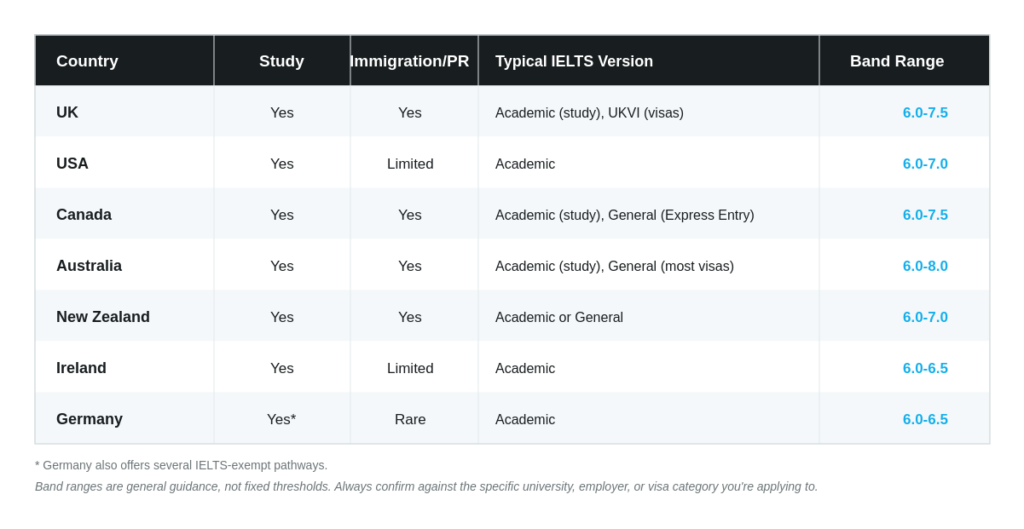
Full comparison table
Band ranges are general guidance, not fixed thresholds. Always confirm against the specific university, employer, or visa category you’re applying to.
Countries that accept IELTS: why this list can change
Requirements shift more often than most guides acknowledge. Australia raised its student visa English minimum from 5.5 to 6.0 in 2024, and similar adjustments happen periodically across other countries as policy changes. Treat any country-requirement list, including this one, as a starting point for research rather than a final answer, and confirm current requirements directly against the university’s admissions page or the relevant immigration authority’s official site before making a testing or application decision.
FAQ
Which countries don’t require IELTS?
Countries where you completed English-medium education may waive the requirement entirely via an MOI letter. Some universities also accept PTE, TOEFL, or Duolingo instead.
Is IELTS Academic or General needed for immigration?
It depends on the country and pathway. Canada’s Express Entry reads IELTS General, while a Canadian university offer reads IELTS Academic. The UK requires IELTS for UKVI specifically for visa applications. Always check the specific pathway, not just the country.
How long is an IELTS score valid?
Two years from the test date, across nearly all countries and purposes.
Can one IELTS score work for both a student visa and later PR?
Sometimes, but not always, since study and immigration pathways can require different versions of the test (as with Canada), and the two-year validity window may lapse between your study application and a later PR application.
Reach out to us at IELTS Sutra, email us at contact@ieltssutra.com, or call +91 9056513461.
Also read: IELTS vs TOEFL: which one to choose in 2026?
Pingback: IELTS Preparation Time: How Many Days Do You Actually Need?