
Here’s a question I get asked more than almost any other: “Which IELTS am I even supposed to take – IELTS academic or general training?”
And honestly, it’s a fair question — because nowhere on the booking page does anyone sit you down and explain the difference between IELTS Academic and General Training in a way that actually maps to your situation. You just see two options and a countdown timer to pick one. So let’s fix that properly, right now, before you book anything.
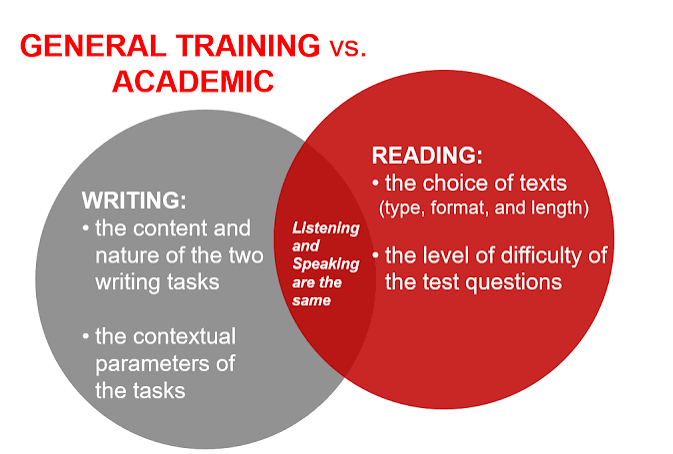
The One-Line Answer First ( Which One Is For Me – IELTS Academic Or General Training ?)
If you’re heading to a university abroad, you almost certainly need IELTS Academic. If you’re moving abroad for work, permanent residency, or a role below degree level, you need IELTS General Training. That’s the 80% rule that covers most people reading this.
But — and this is where most guides stop too early — there are real exceptions (nurses, UKVI applicants, people doing both study and PR back-to-back), and the “which IELTS should I take” question gets genuinely more complicated depending on your specific pathway. So let’s go deeper.
What’s Actually Different Between the Two
Both tests share more than they differ on. The timing is identical — 2 hours 45 minutes total. The registration process is the same. Most test centers offer both. And Listening and Speaking? Word for word, question for question, identical difficulty, identical format, no matter which one you book.
The difference between IELTS Academic and General Training comes down to two sections only:
| Feature | IELTS Academic | IELTS General Training |
|---|---|---|
| Purpose | University admissions, professional registration | Work, migration, secondary education, vocational training |
| Reading | 3 long passages from journals, books, academic sources | Shorter texts: notices, adverts, workplace material, one longer passage |
| Writing Task 1 | Describe a graph, chart, table, or diagram | Write a formal, semi-formal, or informal letter |
| Writing Task 2 | Essay on abstract, academic topics | Essay on everyday, general-interest topics |
| Listening | Identical to General | Identical to Academic |
| Speaking | Identical to General | Identical to Academic |
| Scoring scale | Band 1–9 | Band 1–9 |
The Part Nobody Explains Properly: Is IELTS General Training Actually “Easier” ?
You’ve probably heard someone say General Training is the easier version. Here’s the more honest answer: the content is easier, but the scoring curve isn’t necessarily kinder to you.
Academic Reading passages are conceptually denser — you’re working through analytical, sometimes abstract academic material. General Training Reading uses simpler, more everyday language. But because the content is more accessible, General Training’s scoring is calibrated more strictly — you typically need more correct answers out of 40 to land the same band score compared to Academic. So “easier” isn’t quite the right word. It’s more accurate to say General rewards accuracy more than it rewards raw comprehension effort.
This matters practically: if you’re weighing “should I just take General since it sounds simpler,” don’t make that call based on ease alone — make it based on what your university, employer, or immigration authority actually requires. The content difficulty was never really the deciding factor.
Which IELTS Should I Take? A Quick Decision Framework
Run through these in order:
- Are you applying to a university or degree program abroad? → IELTS Academic. Almost every university, undergraduate or postgraduate, requires this version specifically.
- Are you applying for permanent residency, a skilled work visa, or migration? → IELTS General Training, in the vast majority of cases.
- Are you applying to a UK visa route specifically? → You may need IELTS for UKVI, a version approved specifically for UK Home Office applications — check which one (Academic or General) your visa category requires, since UKVI comes in both flavors.
- Are you a nurse, doctor, or healthcare professional seeking registration abroad? → Some healthcare regulatory bodies have their own specific requirements that don’t always follow the standard Academic/General split — verify with your registering body directly before booking.
- Are you planning to study now and apply for PR later? → You may end up needing both at different stages: Academic for your university application now, General Training when it’s time to apply for permanent residency.
IELTS Academic or General for Canada — Let’s Settle This Clearly
This is one of the most searched, and most got-wrong, questions in the entire IELTS space — so let’s be precise about it.
For university admission in Canada: you need IELTS Academic. Almost every Canadian college and university asks for this version specifically.
For Express Entry and most federal PR pathways (Federal Skilled Worker, Canadian Experience Class, Federal Skilled Trades): IRCC’s guidance is consistent on this — you need IELTS General Training. IELTS Academic scores are not accepted for these Express Entry streams, and submitting the wrong version is one of the most avoidable, costly mistakes applicants make — it means rebooking, retesting, and losing months of timeline.
A structure worth knowing if you’re planning to both study and settle in Canada: many students take IELTS Academic first for their study permit and university application, then sit IELTS General Training separately when they’re ready to apply for PR after graduation. Two different tests, two different purposes, and yes, that sometimes means testing twice.
One more thing worth double-checking, always: IRCC’s requirements do get updated, and some newer pathways or provincial programs occasionally have their own nuances. Before you book, confirm directly on the official IRCC site or with your immigration consultant which exact test version your specific stream requires — don’t rely on a blog (this one included) as your final word on a decision this consequential.
A Quick Myth to Clear Up
“IELTS General is only for people who didn’t get into university.” Not true, and it’s a strange myth that persists. General Training is a legitimate, purpose-built test for anyone whose goal is work, migration, or vocational study — it’s not a fallback or a lesser version. It tests a different set of real-world English skills, not a lower bar.
So, Which One Do You Actually Need?
If you’re still unsure after all of this, it usually comes down to one simple check: ask the institution, employer, or immigration authority you’re applying to which version they require, and get it in writing if you can. Every difference we’ve covered here — Reading content, Writing tasks, scoring curve — only matters once you know that one answer. Everything else is preparation strategy, which is where the real work begins.
I run live online IELTS coaching sessions at IELTS Sutra, where we work through exactly this kind of test-selection and section-wise preparation in real time.
DM me on Instagram @ieltssutra or reach out at contact@ieltssutra.com — I’d love to help you pick the right test and get past the Band 6 ceiling into Band 7 territory.
📚 Join our free WhatsApp group for IELTS Speaking practice material: Click here to join
🎓 Want to join our online IELTS prep classes? Visit our website IELTSsutra
Contact us at the numbers below.
💬 WhatsApp: +91 8360853247 📞 Call: +91 9056513461
Also read : IELTS Exam Pattern and Syllabus 2026